
Book Review
The Too-Tidy Frame: James, by Percival Everett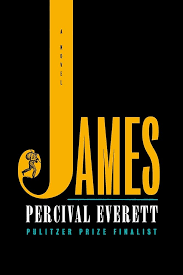
There is a lie that structures every level of our discourse and which, manifested now by bite-sized bullet points, reflects the all-too-“tidy” frame that Percival Everett, in his novel, James, aims to bust up and expose. Judge Thatcher is both the novel’s proponent of that structure and its best educated representative, not only because he is a lawyer and enslaver, but because his library includes some of that structure’s creators and most ardent defenders. James, Everett’s eponymous iteration of Mark Twain’s Jim, has secretly been perusing that library and holding deliberations with its frame makers—among them, Voltaire, Locke and Rousseau:
I had already come to understand the tidiness of lies, the lesson learned from the stories told by white people seeking to justify my circumstance…. I was not interested in the content of the work, but its structure, the movement of it…
“Tidiness” is the structure that preserves that story, keeps it cohesive and airtight, allowing it to say all the right things, virtue signal until the cows come home, while creating character arcs that reproduce injustice. “Tidiness” is the frame, meant to obscure what it is promulgated to preserve—the always-streaming story of the First Person, the very subjectivity denied the enslaved person. James has no access to the so-called “hero’s journey.”
When he exposes John Locke’s hypocrisy for slipping slavery into the Carolinia constitution, and Locke can only defend himself with “it was a job,” justifiable “if someone pays you enough,” we can hear the ubiquitous guffaw that reinforces an already enforceable position—liberal, forward-looking, imagining a better world while ensuring its own security. For the lie, it’s form that matters, phrenology:
“What you’re saying is that if someone pays you enough it’s okay to abandon what you have claimed to understand as moral and right.”
“When you put it that way,” he said.
“When I put it that way what?”
“They wanted a constitution that would justify their behavior. If I hadn’t written it for them, someone else would have. What in the world would be different if that had happened?”
If American literature begins, as Hemingway said, with Mark Twain’s Huckleberry Finn, it is because it reproduced the way we really spoke. Everett, however, gives “Jim” two voices, and two identities, one of which points out, in his encounters with the thinkers who inspired our framers, that they had two voices as well—theirs the hypocrisy of speaking out of both sides of their mouths. Voltaire, for example, “an abolitionist of the first order,” nevertheless asks James to admit to “the presence of…the devil…in your African humans.”
Autobiography is a sequential narrative that moves towards its own origin. So Everett’s larger project, with respect to the country, is also a forward motion that moves towards the country’s beginning: “In the religious preachings of my white captors,” James writes, “I am a victim of the Curse of Ham.” As in all spiritual autobiography, James struggles to stand outside of time—reading should allow it, but even among Yeats’ monuments of unageing intellect, James can’t find rest, and is forced to engage in a form of reparative reading with the very classical texts, including the Bible, in which he begins to discover that the “tidy” form teaches not only how to lie, but also how to stay silent, to not witness, not pay attention.
Everett is clearly intent on starting over. The book opens with a collection of songs from the notebook of Daniel Decatur Emmett, the real-life progenitor of blackface minstrel performance, the same notebook on which James overwrites his story, literally following Wilde’s dictum that the one duty we owe to history is to rewrite it.
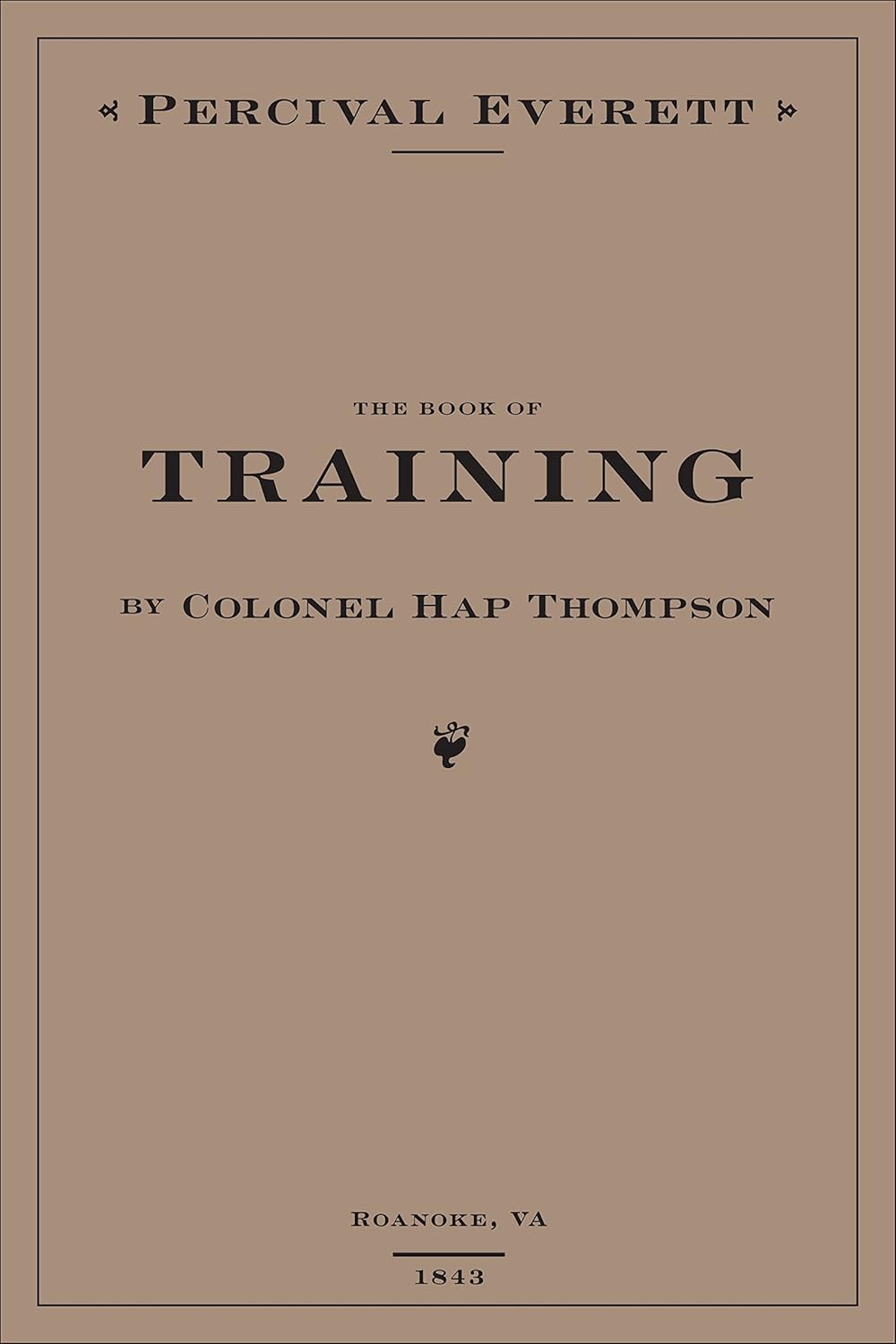 Voltaire’s “best of all possible worlds” is slyly embedded in the very first line of The Book of Training, Everett’s latest volume of poetry, in which the “author,” Colonel Hap Thompson, “a land-owning white gentleman of the American Southern state of Virginia,” invokes it to describe a world where the slave has been with his master since birth. Because James, too, invokes this philosopher of equality, exposing his hypocrisy regarding slavery, one senses in Everett a thinly buried contempt.
Everett won the Pulitzer Prize for James, but has said that literary awards are offensive, perhaps, at least in part, because they are the product of a monoculture in which, as James tells his children, white people “need to name everything.” When teaching his children how to tell (and not tell) a white person they have caused a fire, James repurposes the Socratic method:
“So, let’s pause to review some of the basics.”
“Don’t make eye contact,” a boy said.
“Right, Virgil.”
“Never speak first,” a girl said.
“That’s correct, February,” I said.
Lizzie looked at the other children and then back to me. “Never address any subject directly when talking to another slave,” she said.
“What do we call that?” I asked.
Together they said, “Signifying.”
Luke, another enslaved man in the novel, will note “white people’s love of buying things” while discussing with James the difference between proleptic and dramatic irony, but the figurative distance between the literal and the metaphorical, the surface and the latent, saying one thing and meaning another that “signifying” denotes, is here also partly repurposed into saying one thing and meaning two—Everett’s original take on an abiding practice and resource for African Americans. Kidnapped by James, and threatened with death, Judge Thatcher is outraged, more than anything else, by his slave’s speech, an outrage exposing not only his library but the so-called “great conversation” between the authors of the “Great Books.”
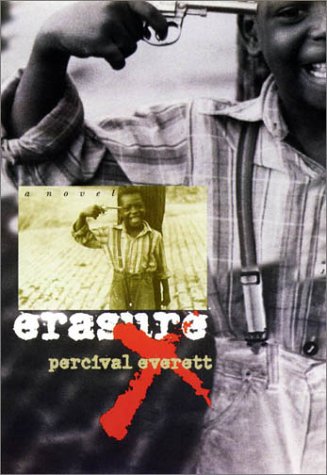
Images of African Americans were first distributed to support polygenism, and in “show don’t tell,” the TED Talk, the classroom rubric, AI’s bullet points, the frames for these images persist. Erasure, another Everett novel—made into the movie American Fiction—begins with an epigraph from Twain and exposes the publishing industry’s devotion to another iteration of that phrenology:
From a reviewer [of a novel by protagonist Thelonious Monk Ellison]:
The novel is finely crafted, with fully developed characters, rich language and subtle play with the plot, but one is lost to understand what the reworking of Aeschylus’ The Persians has to do with the African American experience.
Fascism is not only rewriting the past to control the future, but the kind of liberality offered to secure an already established position. James teaches not only how to cipher, but how to fulfill the expectations of his oppressors, his secret elocution lessons for Black children teaching them how to fracture rather than refine their speech. For James the writer, therefore, there is no precedent for his story—not in Judge Thatcher’s library, nor on the river, or “the road” that will come to symbolize American literature’s place for the imagination of freedom. James writes as a runaway, without the straight road available to a Kerouac. Like Jesmyn Ward’s Salvage the Bones, James is a counterstory, what Edward Said might have called a contrapuntal novel, writing back to the American canon,
If the book opens with the framing device of the racist, minstrel songs deployed as racist entertainment, the pencil represents not only the enslavers, but the framed story told by John Locke, and other foundational thinkers, one that is threatened by the enslaved people having the power to communicate. Everett gives Jim a voice denied by Twain, a first-person narration of eloquence the original author could not have imagined: “Tell your story tell with your ears,” James is told, and we come understand, that to someone in his condition, we live in an Audible State. Young George, who steals the pencil at the cost of his life, tells James he can’t play the banjo he made with his own hands, even if nobody is around, because “sound travels.” When James sees Young George beaten for stealing that pencil, he notes that “the sound became a part of the torture.” “The sounds of the dogs” often has James acting out of well-placed fear:
Deep in the night from deep in the forest, I heard the barking and howling of hounds. I pulled myself into an even tighter ball atop the tree roots that had become my bed. There was a mama raccoon that lived in the tree. She had taken to walking past me nonchalantly in the darkness. Tonight she stayed in the tree, high above me, listening to the dogs. We were both animals and we didn’t know which of us was the prey. We accepted that we both were. I considered running, leaving my raccoon friend, but in which direction does one run from lightning?
The river speaks in both Huckleberry Finn and James but says different things—twain, Samuel Clemens’ pseudonym, is a navigational term, but for Everett the river is a house of spirits that he insists on calling alive. In America, corporations have legal personhood, rivers don’t. James’ conversations with foundational philosophers may be a tussle with madness, but they are also a forum for returning to the origins of the story created to maintain itself and assert its own innocence. The river is its gaslit background of voices:
“LISTEN TO DAT,” I said to Huck.
“What?”
“Listen.”
“I don’t hear nothing.”
“Dat’s it, Huck. Dat’s da riber talkin’ to hersef.”
“What she sayin’?” the boy asked.
“Dat’s fer her to know and fer us to figger out.” I looked downriver. “Dere’s anudder voice.”
Huck closed his eyes and listened. “I don’t hear it.”
“It’s the Ohio, Huck. She be tellin’ dat ol’ Mississip ‘bout freedom…”
Huckleberry Finn does not end with Huck’s decision to go to hell for Jim. The oft-praised decision is a pretext for the minstrel show to follow, the minstrel show that begins Everett’s novel and from whose script James steals the baton:
“Why you holdin’ them books?” Huck asked.
“Dey feels good,” I said.
“That’s funny. How kin a book feel good?” He grabbed the Rousseau and thumbed through it. “It ain’t even got pictures.”
“I likes the weight of ‘em,” I said.
Huck stared at me for a long few seconds. “I guess I don’t understand niggers,” he said.
In the end, “tidy” is an aesthetic category best suited for maintaining the lie in which the everyday practices of “liberal” society keep replicating themselves, trojan horses for their opposite numbers—the difference between rhetoric and reality that the tidy frame is meant to conceal which, rather than revealing the world, frames people and things as extractive resources. The form is the technology that now technology is locking into place—behind Joseph Campbell’s “hero with a thousand faces,” click like endlessly encouraged, endlessly sold in technology-wired classrooms, brand name “learning” platforms, and aggregated bite-sized lies.
The culture of the enslavers was quintessentially classical—plantation houses with Roman columns, the enslaved people with classical names, bookcases filled with the volumes of Greek tragedy carrying the unconscious guilt of their project while forecasting its demise. Revenge is one of the great themes of that literature. James begins and ends in fire—one hypothetical, one real, but both about language. The dish served cold has never been conceived as speaking proper English—this dish not only for Judge Thatcher but for the overseer, Hopkins, just before James kills him. “Which would frighten you more?” James asks Hopkins, “A slave who is crazy or a slave who is sane and sees you clearly?”
James, a double runaway, reflects revenge’s doubleness, its sense of crime compounded on crime. James is a book about double-voicedness, where even Brock, a fellow slave, dislikes James’ language—a kind of infernal irony impossible to capture in a “tidy” story. In a final irony, James’s “revenge”—following the classical model—will likely only increase the cost of his initial action, a secondary cost incurred in a futile attempt to avoid the primary cost.
The elocution lessons with respect to fire at the beginning of the book fulfill themselves at the end when James sets fire not only to the breeding farm but to the “tidy” structure that requires those lessons. Everett, in his introduction as guest editor to the Fall 2014 edition of Ploughshares, says he looked for “stories that push language, that challenge the notion of storytelling.” Everett’s work cannot be classified—no tidy form could encompass his corpus that includes revisions of classical mythology and westerns, The Book of Training and James.
Instead of a tidy road with a coherent narrative structure, James finds, in his conversations with philosophers, an impossible knot in which the only way to find meaning is to create it. In a final turn of the screw, it is the very philosophers James decries to whom he will turn to articulate his theory and justification for revenge. It is in his last conversation with John Locke where he finds his right to fight back, Locke’s silence on the subject of all-out war the caesura suggesting how ordinary the violence against enslaved people was for the functioning of society, the missing archive, as the 1619 Project might suggest, lending a “bi-lingualism” to such key terms as “freedom,” “democracy,” and “human rights.”
James is constructed as an object of property, and therefore it is to the philosophers of property Everett turns to—John Locke and Rousseau, whose Discourse on Inequality will be constructed as the law that binds him. What James is denied is the right to subjectivity (privacy) and in this sense the pencil, and writing with it, are a threat. An object of property is silent. It can be read but it cannot read. On the Graham Farm, for Sadie, James’ wife, or for Sammy, an enslaved girl, property is duplicated in rape. As Rousseau said, “The first man who, having enclosed a piece of ground, bethought himself of saying This is mine, and found people simple enough to believe him, was the real founder of civil society.”
It is the tidy frame, a form that obscures as much as it discloses, that lynched a person for a pencil, that Everett exposes as requiring “bilingual engagement,” the “tidy” frame “music for idiots,” as Norman, another enslaved man, describes Emmett’s songs. To try to write something outside that discourse, however, a language counter to “enlightenment” principles, bullet points that fill the archives like account books, “data” that makes suffering illegible and periodizes our engagement with the world—a road that accounts for back switches, nonlinear “progress” where kindness is always seeming, the threat of re-capture always looming, Everett had to write a counter-narrative in which one is always subject to the existential rug pull that is the untidy reality of the enslaved narrator’s “hero’s journey,” a journey not falling within any of the recognizable genres:
“Who are you?”
“My name is James. I’m going to get my family. You can come with me or you can stay here. You can come and try freedom or you can stay here. You can die with me trying to find freedom or you can stay here and be dead anyway. My name is James.”
“Morris.”
“Harvey.”
“Llewelyn.”
“Buck.” This from the smallest of them. “Let’s go.”
Albert Kapikian is editor-in-chief of Potomac Review.
