
by Noa Nissim Kobliner, Potomac Review intern, spring 2025
Robert L. Giron is a retired English, creative writing, and ESL professor; the founder of Gival Press and ArLiJo; and an editor for Potomac Review. In addition, Giron is fluent in three languages (English, Spanish, and French). I had the pleasure of interviewing Robert Giron on Thursday, April 10th, 2025. In our interview, Giron stood out to me as a natural educator, and he demonstrated a care for details about his family’s history, discussing his timeline with specific dates, adding global historical references when he saw fit. Giron’s attention to detail is compelling, and his narrative style of discussing his life and career rendered the interview content, vast and interconnected.
In the earlier parts of the interview, not printed here, Giron discussed an influential trip he made to Paris, which ultimately drew him to the Metro Washington, DC area; first to Maryland, then DC, then Maryland again, and finally to Virginia, where he currently resides in Arlington. The Paris trip in 1979, his second time there, had a three-fold purpose: travel, looking for work in Paris or France in general, and the possibility of relocating to Paris. He states that, fortunately, he “chose not to stay in Paris as an illegal alien.” Giron also discussed Gival Press, highlighting the 85 books and 47 eBooks published in 27 years, and he mentioned his work with literary contests.
Having retired from teaching at Montgomery College in 2018, Giron has not stopped working. He still runs Gival Press, serves as Editor-in-Chief for ArLiJo, and reads submissions for the Gival Press Oscar Wilde Award and Short Story Award. Giron mentioned having more time now in retirement to write and send out submissions of his own.
The excerpts that follow, edited for space and clarity, relay parts of Giron’s story in his own words. Giron also described his writing process and discussed his poem “The Chair, Father’s Day June 21, 2020.”
On Family Origins
My father’s father’s father (my great-great-grandfather) began his family life in El Paso. That region at the time was part of Spain. Later, it became part of Mexico, then part of the Republic of Texas, and eventually part of the United States. My father’s father left Texas during the Depression and moved to Nebraska. That’s where my father met my mother. I grew up there in the middle of the Midwest, but my family moved back to El Paso in 1958, when I was six. So, in a way—my family starting in what is now near El Paso, moving to Nebraska, then, some of us returning to El Paso—it’s like a circle.
Spiritual Gifts
We were raised Roman Catholic. Although I don’t really go to church, I am very spiritual. When I was a baby, my aunt said to my grandmother and my mother, “This child has a gift.” In Spanish, it’s don, d-o-n, and it means a spiritual or supernatural gift. It wasn’t like I was going to be able to move mountains, but I can perceive things before they happen.
On Thoughts and Magnets
I tell my sister, who sometimes worries too much—and I had to learn this myself for a long time— “your thoughts create your world.” In other words, if you keep saying I’m bad, I’m bad, I’m bad, then, not only will you believe that you’re bad and you’re not worth anything, but you will also attract, like a magnet, evil and bad emotions. The reverse is, if you believe you have confidence and you believe that there is goodness, like a magnet, you will attract it to you.
On Becoming a Publisher
I knew I wanted to do publishing and writing, and so, after a semester studying Comparative Literature in Ann Arbor in the fall of 1979, I decided to return to El Paso to pursue that vision. A couple of years earlier, I had met a Mexican writer, a dentist, and he had shown me his first and only collection of poetry. I had asked him if I could translate it for him, and he liked my translation. I had been trying to find some place to publish it (the English translation alongside the Spanish original), but hadn’t been able to find a venue. In the back of my mind, I thought, “Oh, I could maybe publish this myself . . .”
On Dancing and Creativity
Something I’ve always done, even in my twenties, is go to discos because I love to dance. I would arrive at 10:30 and leave at 2 AM and would basically dance the whole time.
In some cultures, people, while dancing, go into a trance. Dancing lifts them out of their body and makes them open to things that could reach them. In some African tribes, dancing becomes a spiritual experience. And for some Native Americans, when they dance, they’re also doing something spiritual. Dancing puts the body in a different state of being. It allows you to become open. But you have to be careful, because if you open yourself to negativity, remember, the magnet that attracts negativity will bring you down.
When I was in Venice in 1975, I went to a bar and noticed that people just got up by themselves and started dancing. In the United States at that time, people would think you were cuckoo for doing that. But I thought, well, if they can do it, then I can do it.
In more recent years, when we’ve been on cruises, my husband, Ken, doesn’t go dancing, so I dance by myself. I have a good time, because I’m in my own little world. Some people might say, That guy is a little strange, but I’ve gotten to the point where I say, I don’t care what they think.
Dancing, like any form of exercise, releases endorphins. While dancing or exercising rigorously, the body will first ache, but then it will release the endorphins, and it’s those endorphins that allow your body to open up. I usually pray as I’m dancing.
Now that I am retired and don’t have to teach, I can stay up until midnight. I will dance in the basement. All my neighbors know that I dance, because sometimes you can actually feel the house shake. (Somehow, my husband falls asleep with earplugs).
After dancing, I sit and cool off. Often, that’s when I write in my journal, and inspiration will strike. It’s sort of like going into a trance. It’s as if something gives you a gift. You’re open to it, and so it just pops in. Sometimes, there may not be anything there, but then a word, or a feeling, or an image, or a memory will come to me, and I’ll start to write.
On Future Writing
I really want to start writing more fiction. Although, in my case, it’s sort of like taking reality and then fictionalizing it to protect the innocent or the guilty (and also, to avoid getting sued).
I’d like to focus on telling what my grandparents and my great-grandparents told me and the times they lived in. My great aunt and, especially, my maternal grandmother would tell me stories about what happened to them as children, or when they were growing up, or when they got married.
Many people don’t realize it, but there was a lot of discrimination in Texas. Even though Texas belonged to Mexico and before that, to the Spanish, people forget that before that, it belonged to the Native Americans–the Apache, the Comanche, the Arapaho, and different Native American tribes. And yes, some of them intermarried with the Spanish, but others intermarried with the Anglo Americans who later moved into Texas.
After gaining its independence from Spain, Mexico was afraid that either Spain or France would invade Mexico. They told Americans from the East, “You can come into Texas and live. You can bring your cattle and your family, but you have to convert to Catholicism, and you cannot bring your slaves.” But they came with their slaves, and they came with their Protestantism, and they did not want to change. And Mexico said, “No, you can’t. You have to follow the rules of our country.” And that’s why there was the war between Mexico and Texas, and then Texas became an independent republic.
On “The Chair, Father’s Day June 21, 2020”
(Poem Reprinted Below)
I wrote this poem about my father, who unfortunately, passed away in 2021, four days shy of being 101.
In 2017, my mother was diagnosed with dementia, and my father didn’t know how to handle it, so I took a semester of leave to help out. One day, I took my father to Easter Mass, and I wanted to take a picture, but he didn’t want to show his cane in the photo. He was a soldier who survived World War II. He was injured in battle and earned a Purple Heart. He didn’t want people to see him walking with a cane.
Then, unfortunately, one day, he was at a cafeteria-style restaurant. Holding a tray, he lost control and fell, fracturing his hip. At 99, he was too old for surgery. He had to heal on his own and eventually was limited to a wheelchair.
I wrote this poem commemorating his time in World War II. Two of his brothers were deployed with him. Ernie went to Italy. Louis, the oldest, went to Austria. My father went to England and then to France and marched with his unit from Normandy, through Lorraine, all the way to Luxembourg.
As he was marching, truck after truck after truck would pass. Men were piled on top of each other, all of them dead. “Imagine how I felt,” my father later told me. He feared that he too might soon face that fate, that he “might be put on a truck like a toothpick, like lumber.”
As my father was marching, he passed through a town called Gironville-sous-les-côtes, (in French, by the mountain), which is my last name with the v i l l e, which means the village of Giron. I have a picture of Gironville hanging on my wall, given to me by the mayor of the city.
While marching through Lorraine, my father saw stores and posters that said ‘LeRoy.’ And so, I received the middle name LeRoy, which means the king. His first name is Robert, and my sister got the name Virginia Lorraine. Upon hearing about this town with our last name, I was adamant that our family might have some connection to Lorraine.
In 1995 in Philadelphia, I was in a bookstore with Ken, looking at a map of France, and I said, ‘You know, I’ve always wanted to find out where this little town of Gironville is.” Ken, who sometimes has the eye of a hawk, looked at the map and said, “Here it is.” And I said, “oh wow, I think I’m going to write to them.”
I have an ancestry book that tells you what your last name means and where the people with the last name live in the world. It lists all the Girons in the Lorraine area and in France and other places in the world. And so, I wrote to the Girons in that area, explaining who I was, who my father was: that he had passed through Lorraine and fought in World War II, that one brother had served in Austria, his other brother in Italy. The people invited me to visit, so in January 1997, which fell on Epiphany, I traveled there, and I’ve been communicating with them since, by letter, by telephone, by email, and now via WhatsApp. So, are we related? If we are, it’s very, very distant, going back to maybe the late 1600s or early 1700s, but they have accepted me as a distant cousin.
Towards the end, the poem talks about the Bronze Star. I learned that to receive this honor, you must petition your representatives. So, I wrote to my representative here in Arlington, but he said, “Well, since your father lives in El Paso, Texas, you need to contact the representative there.” We did, and the government graciously gave my father a Bronze Star for his bravery and service 70 years after he should have received it. He made the city paper and the local TV stations when he received the honor at Fort Bliss, with other soldiers who received their awards as well.
I wrote this poem for Father’s Day in 2020, during Covid. As far as we know, my father never caught Covid, but after he fell, unfortunately, he had to be moved to the Veterans Home in El Paso. So, I wrote the poem about him, and I read it to him. Afterwards, he said, “Oh, this is a good poem.” That’s the very first time in my life that I ever heard him say, “Oh, your poetry is good.”
The Chair, Father’s Day June 21, 2020
So here we are, Dad,
your worse fear came to pass,
now you’re in the chair.
How you pushed yourself
to walk again after the fall—
we all rallied around you.
Then reality settled in:
baby steps, even if with
one leg dragging a bit.
You recall that
trek through France
watching truck after truck
drive by with bodies
of young and not so young
stacked like toothpicks.
Keep looking forward,
wanting the best.
A bit of happiness
when you saw Louie
near Luxembourg—
wondering if it
would be your last
time to see each
other but glad to hug,
praying brother Ernie
in Italy was okay.
Back to your troop,
filled with cheer,
you joined the march
to the battle—
then shrap metal hit your
back and buttocks—you
pulled through—others didn’t.
Wounded for life—
ignore the pain—
I’m strong—
yea, you are.
Then two years before
your 100th a simple turn,
a stray cane—
life changed in a flash.
A bolt of light
hit and poof,
the knight fell.
Now, you curse the chair.
Slowly, daily life has
dwindled to meals, short walks
and opening mail.
Wanting more with mind
sharp, you inhale,
exhaling exasperation,
recalling the trek
through England,
France, Luxembourg and
back to England for recovery.
They presented a Purple Heart—
you earned it.
Then seventy years
later with the help
of many, they gave
you the Bronze Star.
Proud of you, family
applauded once pinned.
Through the years, you kept
a distance, never sharing much.
Now that you’re bound
by the chair, we all have
seen the good and the bad.
The bad we’re all
capable of in despair.
Gently your body
fails, yet your mind
is sharp as glass.
A thought
flitters, captured
in space precious
as Mom all these years.
Though far and near,
we hold you
dear.
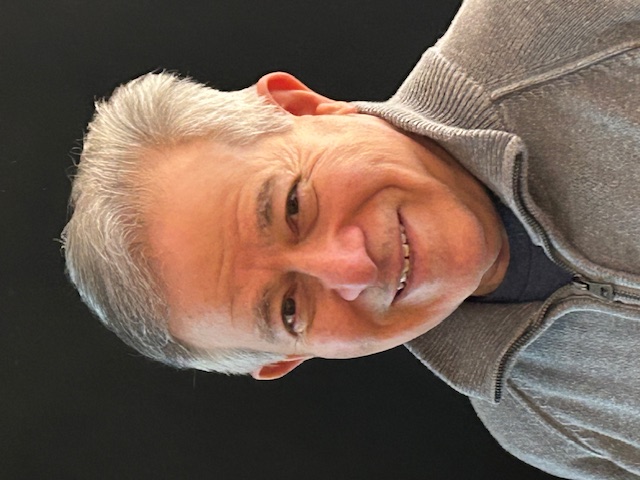
Robert L. Giron is the author of five collections of poetry and editor of five anthologies. His poetry and fiction have appeared in national and international anthologies among other publications. His latest collection of poetry is titled “Songs for the Spirit / Canciones para el Espíritu.” He was born in Nebraska, but he describes himself as a transplanted Texan, with family roots that go back centuries, who lives in Arlington, Virginia. He discovered recently that his ancestry covers most of Europe and the greater Mediterranean area, including Indigenous roots from Mexico/Texas. He describes himself as just a man of the world.