
A Student’s Perspective on Connecting Theory with Practice: Earning Course Credit for Experiential Learning
By Ryan K. Jones, MC student
Overcoming Challenges on the way to MC
Although I dreamt of attending Montgomery College right after high school graduation in 2008, that was not the journey I was meant to take. After receiving my GED in July 2023, I immediately enrolled at MC as a 34-year-old student with 16 years of work experience but zero credit hours.
School had always been difficult for me as I grew up with undiagnosed learning disabilities. Memorization has never been easy or meaningful for me, but I have always been a kinesthetic learner with great people and leadership skills. My high school coaches recognized my learning and teaching abilities and made me a captain on the football, rugby, and lacrosse teams. Later, I suffered a traumatic brain injury, which left me with five plates in my head, epilepsy, and debilitating seizures that erase parts of my memory. Despite these struggles, I took what I learned from these experiences and augmented them into a 16-year career of being a lacrosse coach and mentor at various levels around the world.
Learning at MC
College has definitely been an eye-opening experience. The tempo in college has been faster than I anticipated, and the workload is even heavier than I could have imagined. While my experience at MC has been wholly enjoyable and gratifying, through the coursework I’ve completed
thus far in my college education, there have been times when I thought to myself that something more could be done in course assignments to allow students to feel more of a connection and make the work relate to the real world. I’ve also oftentimes felt that some of the projects I was doing outside of the classroom, driven by my own interests, were not being valued inside the classroom. An example of this is when I co-hosted the Fall Convocation at MC last August. I thoroughly enjoyed the experience, but I wondered why I couldn’t receive any course credit for speaking in front of MC’s administrators, faculty, and staff. Throughout my education, I’ve come to realize the benefits of experiential learning that effectively connects theory with practice, boosts students’ engagement, and enhances real-world application of knowledge.

Ryan Jones speaks at Fall 2025 Convocation
Learning by Doing (Experiential Learning)
When I got to MC, my classes were difficult, but with focused effort, I was able to maintain a 4.0 GPA during my first three semesters. However, during Fall semester in 2024, I was taking PSYC 100 (General Psychology) with Dr. Elise Klein, and I was really struggling to the point where I was concerned that I might not pass the class. Then, Dr. Klein gave us an assignment about the process of breaking or building a habit. Suddenly, the class became more real to me, and my interest was piqued. This assignment motivated me to not only keep going in class, but also to think of ways that I could use it to help others.
The assignment was to pick a habit we wanted to break or build and determine the principles that we learned in class that we would use to achieve this goal. This not only created a platform for learning the course content but also created genuine learning opportunities that actively engaged students in critical thinking in the form of self-evaluation. The opportunity to choose my own habit and learning methods was key to creating an authentic and relevant assignment that made the class come alive to me.
I chose to break the habit of using my cell phone from 9 p.m. – 11:59 p.m. every evening. First, I had to collect baseline data over five days, noting how long I used my phone and what activities I engaged in, including texting, schoolwork, social media, and calls. Using principles of operant conditioning, a behavioral modification theory using rewards and punishments, I tracked phone use and utilized negative reinforcement and positive reinforcement if I did not look at my phone between 9 p.m. – 11:59 p.m. to break the habit, aiming for better rest and improved mental focus. After implementing the operant conditioning, my phone usage went down by 53% during the hours of 9 p.m. – 11:59 p.m. One of the best parts of this assignment was being able to break down the experiment to the point of being able to share it with others, so they could replicate the plan. This assignment resonated with my learning style and also made clear to me the “why” of what I was learning in my psychology class. Real-world applications with a hint of growth are a very big part of education.
This habits assignment was an example of experiential learning, simply defined as learning by doing. David Kolb, who is credited with developing the theory of Experiential Learning, describes the process as a four-step cycle. The first step is Experiencing (Concrete Experience), which means the learner participates in an activity (“What is Experiential Learning”). The next step is Reflecting (Reflective Observation), when the learner has the time to critically think about the experience, incorporating feelings and ideas. The third step is Thinking (Abstract Conceptualization) where the learner reflects on the timing and environment of the experience to hypothetically create theories, principles, or conclusions. The final step is Acting (Active Experimentation) when the learner applies what they learned to new experiences. These steps can be applied to my habit breaking assignment in my PSYC class. For example, I started trying to break my cell phone habit by tracking my current behavior (Experiencing), then reflected on why I use my phone during those hours (Reflecting). I developed a plan using operant conditioning principles (Thinking) and then implemented that plan (Acting).
Many educators and experts in higher education emphasize the importance of experiential learning. Dr. Jermaine F. Williams shared his thoughts about experiential learning at his Spring 2025 Town Hall. He clarified Montgomery College’s perspective of what experiential learning as “learning that involves action, engagement, and opportunities for reflection that are embedded in the real-world structures.” This answers the question about how this term can help students in the real world, not just in an academic setting, bring learning to life. He gave examples of internships, partnerships, and coursework that brings learning to life in our academic setting. He made sure that students heard about the importance of their personal experiential learning. In addition, Dr. Deidre Price, Vice President of Academic Affairs and Provost of MC, suggested to faculty in her Spring 2025 Academic Affairs Address, the need to “incorporate experiential learning and connect course content to real-world applications whenever possible.” The leadership of MC recognizes the importance of experiential learning.
“From FEDS to EDS”: Proof of Concept
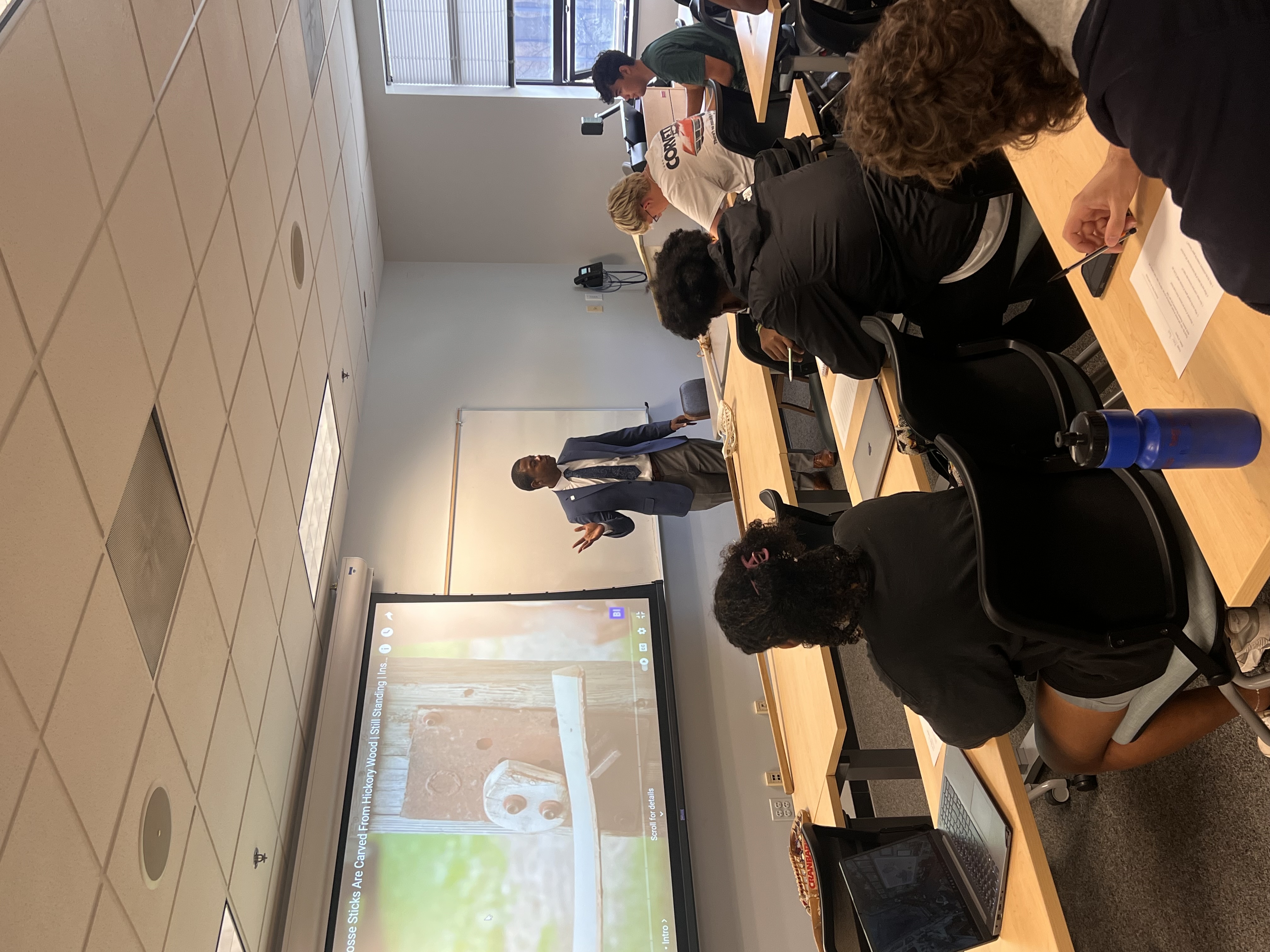
Ryan Jones presents history of lacrosse
As a long-time lacrosse coach, I have built skills that have transferred into the classroom. For two years, I worked as a teacher’s assistant in a DC public school and a DC charter school. Even though I was doing many of the tasks and taking on many of the responsibilities of a primary teacher, I was limited in upward movement within the organization because I did not have the coursework requirements. There is a great deal of emphasis on the credentials necessary, but I think that evaluation of my relevant skills and experiences could have been considered for my benefit and theirs.
Montgomery College has developed a program that now helps people with relevant skills to more quickly get the credentials necessary to become MCPS teachers. Montgomery College has been using experiential knowledge as part of their Alternative Certification for Effective Teachers (ACET) program since 2006. The program seeks to fast-track industry workers seeking career changes into MCPS classrooms. On May 27, 2025, Governor Wes Moore held a roundtable on MC’s Rockville campus with Maryland leaders in higher education and participants in the new program, ACET Flex: From Feds to Eds. At this roundtable, Moore shared that Maryland Higher Education Commission (MHEC) would give $1 million in grants to 11 colleges and universities in Maryland to help federal workers. He announced that a $100,000 grant would be given to MC’s ACET Flex: From Eds to Feds program, which is specifically geared towards supporting displaced federal workers and training them to become MCPS teachers. These workers have vast experience and a college degree, and can now work towards their teaching certification.
Experiential Learning Credit for Students
In that vein, I think that opportunities like that could exist for students to be given the opportunity to use their skills and experiences and apply them for credit in some coursework. I would love to see professors bring their classrooms to life by allowing students to use appropriate experiential learning as an alternative to their assignments. This will allow students to have the opportunity to put on display their hard, soft, and life skills that they have managed to acquire, along with their creativity. For example, if a course requirement is to give a speech in front of an audience, a speech a student gives in another real-world context, like at an MC event, should be considered as credit for that assignment. The student could meet with the professor during office hours and discuss whether the on-campus speech would fulfill the learning objective of an assignment. They could work together to see if the assessment substitution would work in that situation and how the professor could evaluate it.
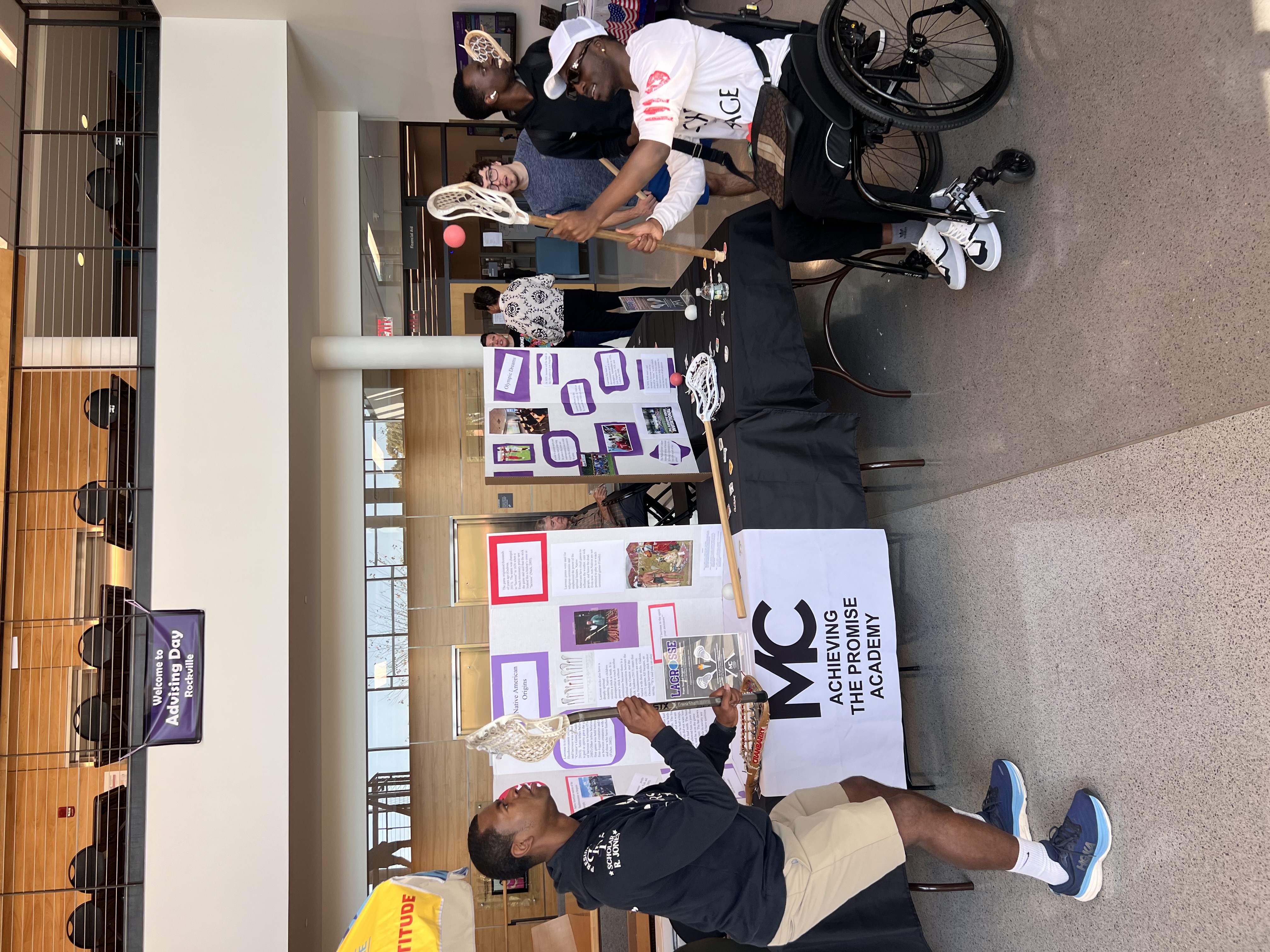
Ryan Jones plays lacrosse with fellow student
In the Fall 2024 semester, I had many opportunities to participate in activities that could potentially be considered for course credit in the future. I was invited to speak to the donors for the Presidential Scholars Program and Montgomery College, and also had the chance to do an interview with WTOP for TRIO while I was taking COMM 108. I think that professors may want to consider activities like these for class credit, or perhaps extra credit. I also had the opportunity to teach the history of lacrosse at Professor Michael Petty’s HIST 190: History of Sport in America and gave a poster presentation on the history of lacrosse and its indigenous roots in conjunction with HIST 190 and ATPA during Humanities Days. I helped to host a mental health awareness day via the sport of lacrosse with ATPA where students got a chance to actually pass, catch, get ground balls, and shoot. Professors may want to consider giving students who engage in relevant learning experiences outside the classroom the opportunity to propose how they may be considered for course credit.
Giving students credit for enhancing Montgomery College and Montgomery College campus life is a way to encourage students to see the value of experiential learning in their education. Helping students see the way their education engages and values real-world experiences is motivating and productive for students. Incorporating opportunities for experiential learning will help them find ways to give back to the college community. This will allow students to take ownership of course assignments and assessments in the future. Increased engagement in the assessment will enhance student critical thinking skills. Finally, giving credit for experiential learning fits with the principles of Universal Design in Learning. The Universal Design Center on MC’s website states that some of the key concepts in Universal Design in Learning are Multiple Means of Engagement, Representation, and Action and Expression. Offering experiential learning as alternative assessments provides learners with options to show what they have understood of course content in a way that lines up with their learning style and strengths.
To conclude, experiential learning with increased engagement between professors and students will not only create genuine learning experiences for students, but it will also give professors the opportunity to see how students are engaging more in class, as I did in my PSYC 100 class. Professors will experience the satisfaction of having students come back and tell them how that experiential learning has influenced their students’ educational journeys. Ultimately, taking action in different ways outside of class is what professors want their students to be able to do with their education. This rewards initiative and values students’ real-life experiences. Although I am not a traditional student, I believe that using alternative methods of assessment through experiential learning will have a powerful educational impact on the next generation of college students, whether they be traditional, non-traditional, dual enrollment, first-generation, or international students.
______________________________________________________________________________________________________________________
References
Institute for Experiential Learning. (2023, December 27). What is experiential learning? https://experientiallearninginstitute.org/what-is-experiential-learning/#:~:text=Experiencing%20%E2%80%93%20Reflecting%20%E2%80%93%20Thinking%20%E2%80%93%20Acting,The%20Experiential%20Learning%20Cycle
MC Distance Education. (2025, January 17). Dr. Deidre Price, Spring 2025 academic affairs opening address [Video]. YouTube. https://www.youtube.com/watch?v=nuw9ieyW2Pk


